Seek...

Showing posts with label intellectual property. Show all posts

Sunday, August 28, 2011

The UNcreative Cebu

I believe that for Creative Cebu to move forward, it's also equally important that the org must challenge itself from within.  To question an existing status quo.  To sort and identify the barriers.  And more importantly, to acknowledge the value of accepting what makes an UN-creative Cebu.

WIPO, IPOPHIL, DTI, Cebu Chamber of Commerce, and Creative Cebu recently sponsored an event called National High Level Forum on Innovation and the Creative Industries Ecosystems.  Branding, evolving business models, and the use of intellectual property as its utility belt were the prevalent agenda.  Insightful it was, yes.  Very informative.  Grandly inspiring.    I'm writing this entry as an attempt to document the experience and knowledge I've savored in that 2-day forum.

My favorite topics were those presented by Brandon Rawson (1st Act, Silicon Valley, USA), Jason Potts (ARC Centre, Brisbane, Australia), Jay Aldeguer (The Islands Group, Cebu, Philippines), and Kenneth Cobonpue exhibiting all his grand offerings to the world.
Jason Potts speaking on customized music business model

And then there was the thought provoking semi-lecture on branding by Mr. Junie del Mundo (CEO, Management Association of the Philippines, Manila).  I'm sure there were other speakers that were equally mind-moving but I missed it due to a pre-scheduled separate appointment (had to leave for a couple of hours and came back).

Bullet pointing all that has transpired, these are the key notes identified in a creative community that caught my fancy:
  • The need to experiment and consequently support it
  • Customized music business model per region
  • The empirical ratio between opportunities versus challenges
  • The empirical ratio between risks versus rewards
  • The proposed action to rebrand the Philippines (and Cebu as a creative hub)
  • The need to draft and enforce applicable policies (whatever this may mean to artists and entrepreneurs alike)
  • And the ironic impact of the use of intellectual property (yes I knew there was a downside to this but couldn't put my finger on it until this forum)
I waited for somebody to scale the above a little bit down and bring forth subjects such as:
  • The need to provide more avenues on financial support especially in the experimental phase of creativity where only a few listen, vision-share, and pay attention to
  • The need to make meaning first - branding via the basic needs on food, clothing, shelter, and transportation
  • That creativity should include science and engineering ergo not limited to music and arts alone
  • Is there an existing policy that supports this?
Nobody did.

So I braved in and expressed (and hopefully contributed) some ideas and opinions.  Here they are;

  • The government should be more aware of "existing experiments" going on around them.  Unless they figure out a way to tap in these potential resources and fund them, these efforts could end up flourishing elsewhere.
  • Branding Cebu is asking what makes it special.
  • "Puso" or hanging rice should be proudly served in hotels and restaurants.
  • In this tropical country, designers could come up with a better idea of a formal attire than the preferred western suit.
  • Houses should be designed with natural ventilation and less air-conditioning necessities, and that low cost houses should mean affordable and functional rather than inadequately cheap.
  • Unless the highest ranking official of every government agency is able to take the jeepney everyday to work, the problem of traffic will only get worse.  Traffic is caused by inefficient public transport resulting to more people buying more cars resulting to more private cars congesting the roads.  Road widening is not the answer.
  • Local government offices should assert on a paperless system of business permit application.  One effective office with an efficient system should be enough.

Learning happens when you acknowledge that there is still more to understand.  You can never learn enough.  And you cannot learn if what you believe is that you know everything.

The same principle applies.  Creativity happens when we learn about what makes an uncreative Cebu.


Friday, January 21, 2011

Memorization supposedly made easy with SpellDial

We often ignore this but we call a friend by first scanning our phonebook starting with the first letter of the name.  For example my name.  And then we get sort down that list to find Ian Zafra.

That's simply because we're all identified by our names and not by our phone numbers.  It's easier to find McDonald's or Jollibee's delivery number by their brand names rather than the number itself.

Albert Padin invented SpellDial to do just that.


I RSVP'd weeks back for tech talk meet up seat in IT Park yesterday and was lucky to have met this 22 year old genius.  Well yes many websites similarly have this type of service such as Zyb.  But most of these sites only provide storage of names in your phonebook and that you have to type or sync in all the numbers from your phone.  Something more like importing data.  That's time consuming.

But what if one of your contacts lost their phone?  What if one of your friends is hiding from an ex-boyfriend and changed her number?  What if your friend added or changed network.

SpellDial's sales pitch empowers phone number owners to update their numbers themselves.  Effectively, if one of your contacts change numbers, assuming your contacts use this service, you can still contact them without you knowing the update.


The logic is very simple and the functionality is very easy to use.  It's a function of self-branding.

However, there are still areas for improvement.  One of which is the ability to acknowledge duplication of names.  For example, there could be several Ian Zafra's in the Philippines and in the world.  The system only recognizes the first to register that name (so I did mine soonest I got home).

Second area of improvement is that it can only work via an internet connection.  Your ordinary phone cannot avail of this (yet).  But if you an iPhone, you can type in my name, for example and call me even without knowing my number.  Just like how the Yellow Pages work.

This is could be helpful for businesses but this is also scary as you are somewhat publicized.

I can name several areas for improvement but these are I think the more important functions that should be prioritized.  Facebook did a good job on the exclusivity measures.

Monday, January 17, 2011

Being original is not about originality anymore

"We're different."

Yeah right.

But are you really?

It's not accurate to claim that you are different and therefore original, especially when you disclose your source.  Keep in mind that everybody wants to be different.  It follows that everybody has the itch to claim that they're original.

The rules of intellectual property says otherwise.  You cannot claim an idea that it's yours.  Period.  An idea always comes from a source... be it from a problem that requires a new approach to creative solutions or simply out of vanity.

You cannot patent, trademark, or copyright an idea.  What you can claim however is the actual product to which your idea is manifested from.

Levi's did not claim that they invented the jeans.  But they can claim about the design quality of the jeans that  they make.  Apple did not claim that they invented laptops.  But they can claim they invented the best design functionality of a laptop in the world.  The Beatles did not claim that they invented British pop music.  But they can claim ownership of their sound recordings.

So next time when you say something about your music, your art, or your product, don't say it's original because it's different.  No.  Because today, no one really cares so much.  It's more about the how without divulging the source than the what.

And chances are every single thing is different from the other already.

Monday, January 3, 2011

What is a copyright infringement?

Protest forums and blogs had been built page after page. It was on the national TV news. The majority of music fans were disappointed. But whatever criticisms made by the public, the song went on to reap its success. Now that it’s not a major buzz anymore, I decided to take a stand on this issue.
Orange and Lemons (photo source: http://fr.babelsound.com/orange-and-lemons)
Despite the prevailing issues that circulated among new wave fans on the claim that the hit single “Pinoy Ako”, the Pinoy Big Brother soundtrack by Orange And Lemons is an obvious “copy” of “Chandelier” by The Care, the fact remains that it soared the charts and became a huge phenomenal hit in the Philippines.

First off, I’d like to point out that this is in no way defending ONL between those who initiated the dispute. The general question I’d like to raise here is if it was an infringement? In my attempt to base my points of view on facts instead of subscribing to some envious new wave group’s criticisms, I am writing this article in the hope of explaining on the context of copyright infringement.

Copyright infringement is when a copyrighted work is being performed, broadcasted in public, uploaded for online distribution without authorization from its owner and with no fees paid as required by law.

For any lawyer or other rightful entity to prove that there is infringement, there must be a substantial evidence to prove that the songwriter supposedly guilty of infringement had access to the original copyrighted work being made. This is the first basis.

To cite an example, a political candidate running for a position in the government in May 2007 used Insoy Niñal’s song “Prinsipal” as an official election campaign jingle. The Cebuano composer confided that there was no permission initiated. What made it worse was that the lyrics were altered to fit the candidate’s campaign platform.

By definition, this is a clear case of infringement and the political candidate and his campaign representatives are guilty. In this incident, there are actually two unlawful act made. The unauthorized use of the song for an election campaign is one. Then there’s the underlying issue of the misrepresentation of the copyrighted material because when Insoy wrote “Prinsipal”, it was not intended for political use.

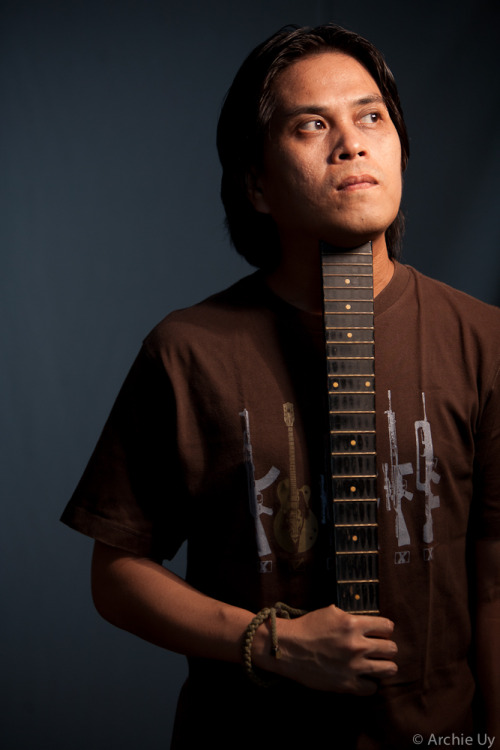
Insoy Niñal
Photo by Archie Uy (Tumblr.com)
The other unauthorized use is the alteration of the lyrics. The music law protects both the music and the lyrics and therefore any alteration of either or both components of a song, if not granted by its owners, is a copyright infringement.

Call it a rip-off if you may as that’s what everybody thinks. But I believe the issue was and still is an opinion of the masses. Ergo, it’s neither right or wrong.

Misrepresentation is a huge issue and in fact, when songs are made as commercial jingles, ad agencies convince publishers and songwriters by offering to pay a hefty sum of money.  Or at least they used to.  This being the usual and logically the appropriate approach, is the price the advertisers have to practically pay to the copyright owners understanding that both parties know that the song in question is valuable to the product being promoted.

The second type of infringement is the unauthorized use of substantial portions of a copyrighted work. Earlier, I cited “Pinoy Ako” being once the favorite subject of scrutiny and criticism among new wave fans debating that the hit song is identical to that pre-existing European track.

As I attempt to explain infringement and the application it served to this dispute, it is of my interest to present examples of situations in the hope of displaying a comprehensive perspective of this issue.

Another note is that the songs were managed by different record companies.

“Pinoy Ako” vs “Chandelier”

The copyright law was conceived to protect the songwriters and music publisher’s rights to a song but not to judge who owns what. No matter how solid and obvious the claim is as in the case of the dispute between “Pinoy Ako” and “Chandelier”, the only way to prove that both songs are the same or identical is to present each of the song’s music sheets in court.

The second proof of evidence is to present music sheets, a certified proof of evidence. that there was an infringement or that the European song was copied. Another solid proof of evidence is if there is proof of access to the copyrighted work (as I mentioned earlier). Even if the issue caught the national media’s attention and no matter how massive the protest of this issue was among new wave fanatics, the last word on the judgment of copyright infringement still lies in court.

Copyright, though it may sound simple in theory can be complicated when applied to actual situations. Many gray areas arise and this becomes a venue to manipulate the facts and evidences. In court it’s not what you know but what your lawyer can do with what you know to win a case.

To conclude, of both types of infringement and their respective examples that I presented here, the political candidate is, without any doubt and stating the obvious, is guilty of infringement. In the second case, the “Pinoy Ako” issue that raised national attention is still but a public opinion and unless a music sheet and a substantial proof of evidence that access to “Chandelier” is presented confidently in court, there is probably no infringement made.

Tuesday, December 28, 2010

Ideas more becoming an important core of the new age

This statement is not new.  In fact, it's been in our lives for ages.  Ideas, even the bad ones, are the reason, if not the only reason why we continually thrive to exist.

If an idea is good, people talk and it spreads bringing other people in.  If an idea is bad, people still talk about it and wait... some would wait until a solution is out.  It's a vicious cycle. And it's wonderful.

Cebu on the other hand is relatively backward in terms of ideas for progress and developments.  Solutions to traffic are always directed to widening of roads instead of improving the public transport systems.  Architecture is unchallenged and boring.  And we have a culture of young English speaking wannabes impressing people with their broken twangs (I'm actually one of them but I'm not young).

My partial theory of this "stoneage" culture is this:

Between the 14th and 17th century, the Renaissance era, Europe produced the world's great philosophers, scientists, artists, and artisans giving birth to concepts on humanism, art, science, religion, and self-awareness.  The Catholic Church on the other hand was busy stopping this cultural movement from propagating.  Of all the countries in Europe, it was only in Spain that the Church succeeded, preventing people from presenting ideas - impeding them to think.

Translating how the Church's political influence and its insecurity impacted the world, countries colonized by Spain had no global recognition up until recently.  The Philippines was colonized in the 16th century.  We are in this roster.

But we can still change that.  We now know that ideas are valuable and therefore important.  Intellectual property is important too not only because it's obligatory to one's brand in business but because it protects the creation and gives the creator a reason to build a reputation around it.  Not many fully understands its value and merits.

To disclose and discuss an idea is one thing.  To put it into action is a totally different shift.  At this point in time, only a few can get it done.  And then fewer can make it through.  Certainly it won't be the cynics.

Tuesday, December 8, 2009

A funny truth about trademarks, copyrights, and patent

When you're in love, don't wallow in the thought of the possibility of losing that special someone.  Instead focus your effort on generosity.

Share anything that can lift your relationship up instead.

Think of things that make both of you laugh, smile, and enjoy every moment.  Bad moments come and are often beyond control.  But the more focused you are in giving, the better things will turn out to be.

Anyhow I'm not any love guru.  What I just said is simply a comparative to an assumed notion about the possibility of losing an idea to another's advantage.

The funny truth is that no body can own an idea.  And another funny truth is, the more you give your idea out, the better it becomes.  It's called brainstorming.  And the third funny truth is no idea is a bad idea.  It just needs good timing and the right opportunity.

Seth explains in layman's term about ideas and its relationship to trademark, copyright, and patent.  If you get my drift, you'll understand why I chose generosity in relationships as an example.

Monday, April 20, 2009

Why indies are most often better?

For a time, our country's film sector had been blaming the pirates for causing the critical slump of their industry, claiming that "new opportunities" had been threatened leading to a premature demise before it could even begin. And so clamors were heard in the dailies from the sector leaders.

Can't blame them. Who wouldn't? After all, when a house is burglarized, it is only but normal and valid to be very seriously concerned about it.

But why now? And what are these "new opportunities" they are talking about?

Because for a long time, Hollywood had been making amazing films year after year after year, while our country's film makers still take the inaapi format approach.

Because it's what sells?

While Hollywood had been making amazing films - from storytelling to technology innovations year after year after year, our country's film makers for a long time prefer the movie-premiere-promotion-approach where movie goers would say ,"Hindi ka pa rin kumukupas idol. Idol ka pa rin!"

Because it's what sells?

One time I was watching a movie in cable channel Cinema One. The scene was in a rice field. In this setting, farmers are supposed to be wearing thin cheap camison clothes for obvious reasons. In that movie, the mestizo/mestiza casts were wearing branded and expensive-looking shirts.

Because it's what sells?

Where is the professionalism in that?

And they blame the pirates for the slump?

I would understand if what the film industry was lobbying about refers to pirated foreign films in DVDs. Personally and not to belittle our race but I don't think the work of our Pinoy film producers deserve to be pirated at all (with a few exceptions). My point here is to establish a comparison of quality between film makers in other countries.

As a viewer and keen observer, unless Pinoy film producers start reeducating the "masa" and their actors/actresses dare not to take stereotype roles and other standard packaging (with some exceptions), they shouldn't be complaining. Oh oh... later we find that those same actors/actresses who can't even pitch the notes right release records.

Unlike Hollywood films where actors professionally immerse in the role becoming the character, our Pinoy actors/actresses play their names, not the characters (with some exceptions). Budget constraints? I don't think so.

Look around us. There are so many creative people these days. And because there are so many of them, indie film makers are slowly coming out like mushrooms. Quality movies are starting to find its audience again and content with substantial stories is what this country needs. But of course we also need daring leaders who can take the risk of getting criticized for doing what is right.

Artists are supposed to open little new perspectives. They come in smaller groups, clustered with other small creative communities residing as indies, underground, radicals, activists, or whatever tag that suits you. They can afford to dare because money is not their main concern. Yet.

For producers who have the capability and resources to experiment on new ideas may opt to decide whether to take that road less traveled and tap these smaller investments or dismiss it for fear of failure. Many for a long while, the bigger fish in the film sectors had failed to see and tap in this potent spring.

Persistence from the indies did wonders and the quality films they delivered are slowly changing our lives for the better. Truly there are only a few enlightened.

The music sector is trying to pave its way as well. Pray for us.

Sunday, March 15, 2009

Music licensing at Indiepinoy.com

The sender agreed to have this email published verbatim on the condition that her band, real names of people, and email addresses will not be disclosed. All for the spirit of sharing. Read on.


from: ****** Band <******@gmail.com>
to (**********@gmail.com
date Fri, Mar 13, 2009 at 11:46 PM
subject Win-Win Strategy, does this one work?
mailed-by gmail.com


Maayong gabii, Ian.

Hope this won't take so much of your time. Attached is a copy of the email the manager had sent... Ako untang ipatan-aw if this one is safe as it sounds, and advantageous at the same time. from earning of the downloads, as B**M**** had said, "It's a win-win strategy".

If there is something about the terms [this is not the contract, yet... daw], do please reply at *******@rock.com.

thanks, again. bai


all the best,
*******

*********************

Hello!

I would encourage you to do check out indiepinoy.com. This is a bigger project that will definitely help you promote your music and market them thru the mobile networks. When interested please send email to indiepinoy include the following:

1. A profile that will include your location, music genre and site links
2. Track listing of EPs, albums please indicate if released or unreleased, if distributed under a label or not.

Note: You can include in the list songs you are about to record since we will be asking for the actual audio files after your band has been presented to the telcos and have been approved. I can always tell them that these audio files will follow soon.

3. Contact details (email and phone number).

The purpose of these information is to present your band to the companies involved in the project. Upon approval, then we will be sending to you the guidelines on what to do including details on the deal.. We will be signing up a contract on this project as it involves licenses. We will only be handling mobile rights. You still will have the liberty to get into any major label deal as long as there are no conflicts on mobile rights. Please note that we do not involve in internet downloads. Everything is mobile and legitimate. You will get revenue share from your songs, a monthly report will be in order.

You can submit your songs already even without the contract yet. Technicians at mymusic can process them immediately to avoid the clutter of work when all the bands has been approved by the telcos. Note that we cannot market your songs without a license contract as this is stated by law. That is for your protection too.

Re your question on revenue share:

The specific figures for revenue share is yet to be finalized. The current status of the project now is that indiepinoy has to submit to the telcos (globe and smart) a list of songs involved in the project. These telcos will not be interested if we have only a few songs to market. In my opinion, just like any business they want to make profit from the project. THat is why I will be submitting more than 1,000 list of songs (not the actula audio files) so that we can get a better deal in the revenue share. Commonly each song is sold at P50 / mobile download (for fulltrack). This is for premier songs under major labels. Other category has a slightly different rate. 50% of these goes to the telcos. And from that the other 50% will be shared be mymusic/indiepinoy and the band. If you can compare the profit rate from royalty on a CD under a major label, indiepinoy still has a bigger figure per song.

If your band will be included in the full promotion, we will require you to alot a song that will be pushed free for download (meaning you will not earn from the downloads of that song for a specific period of time). This is so we can promote the band and the project in full. Promotion involves big expenses in various media.

I hope this clarifies your questions.. If you have any more questions, dont fail to email indiepinoy at indiepinoy@gmail.com

Thanks a lot.


My reply

from Ian Zafra <***********@gmail.com>
to ******* Band <*******@gmail.com>
date Sat, Mar 14, 2009 at 12:12 AM
subject Re: Win-Win Strategy, does this one work?
mailed-by gmail.com


Hello *******,

We may have different preferences and ways in assessing what is worth trying and what is not. Indiepinoy sounds promising and from the looks of it, I would like to believe that this project is run by people, probably musicians themselves with a very strong entrepreneurial spirit. I have so much respect for people like that.

From what I understand, Indiepinoy is a mobile phone content provider. There are actually many of them today but this may be worth a try. Yet if you are doubtful, try listing down the concerns that bother you. My guess is that you're probably looking for a sample of their sales report or at least a template of how it's going to look like and whether or not you can access them yourself. Ask them about it. For all you know, Indiepinoy probably need challenging questions like that especially from unsigned bands. From there maybe you can take your foot one step forward until you get closer to a decision.

Take some time to understand how it works inside out. Make haste slowly. Before I decided on TuneCore, I took a great deal of time reading the FAQ section.

At the end of the day, what really matters is your decision as mine would only be recommendatory. I'm not sure if I'm helping ******* in any way yet I must say your best defense is to learn more about IP and its applications. You can start by reading here


P.S. I hope you won't mind if I blog this... do let me know


She replied

from ****** Band <******@gmail.com>
to Ian Zafra <***********@gmail.com>
date Sun, Mar 15, 2009 at 12:46 PM
subject Re: Win-Win Strategy, does this one work?
mailed-by gmail.com


Thanks for replying back.

I will think over the things you've suggested, and I'll be happy to open this topic with the ladies.
Salamat kaayo, bai.


*********


Blogging: If it helps other people, why not? The more encouragement --the better. However, okay ra if [uber] iscreet lang ang name sa *******? Address the general, yes. B-)

Thanks, again [kaayo], Ian Z.

Thursday, February 12, 2009

Gary Granada complains

Government offices are not the only ones that mess up. Check this recorded testimony from Gary Granada on his "collective effort" with GMA Network.

Saturday, January 17, 2009

I.P. Talk With Meg Eteve

I.P. stands for intellectual property. Meg Eteve is the Executive Director for Creative Cebu's pilot project Tubod Fest slated in March 2009. It was a Bathalad evening at Turtle's Nest last night and I was there to finalize the arrangement for Midweek Sessions' Stripped this Feb. 4 with the local poets.

What transpired in the first hour was an interesting talk with Meg on I.P. - about what Cebu's artists need, already have, and should improve or aim for. In synopsis, below is the outline:

What Cebu has:
1. Artists/Musicians
2. Songwriters
3. Event Producers

What we don’t have:
1. Music publishers
2. Performance Royalty Organizations (FILSCAP)
3. Regular airplay
4. Media venues
5. Record companies
6. Entertainment lawyers
7. Documentation

Of course the conversation didn't exactly go this way... duh

I hope artists/musicians/songwriters would take some time to consider joining Creative Cebu. I for one am strongly for it as I see this as a really good opportunity to "repackage" our perspective. Do drop by the music sector forum and tell us what you have in mind.
Related Posts Plugin for WordPress, Blogger...